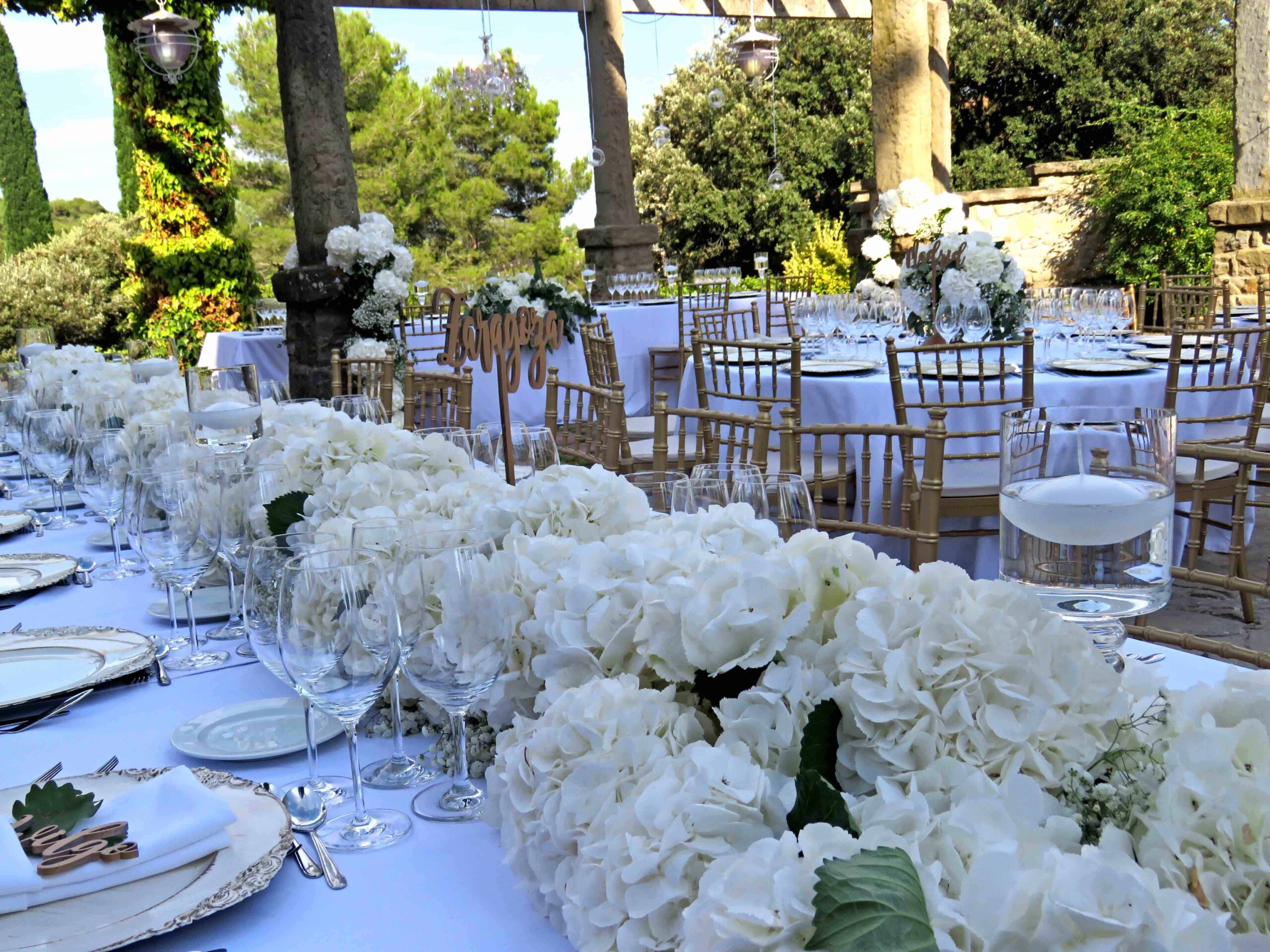

Wedding Flowers and Floral Design in Barcelona
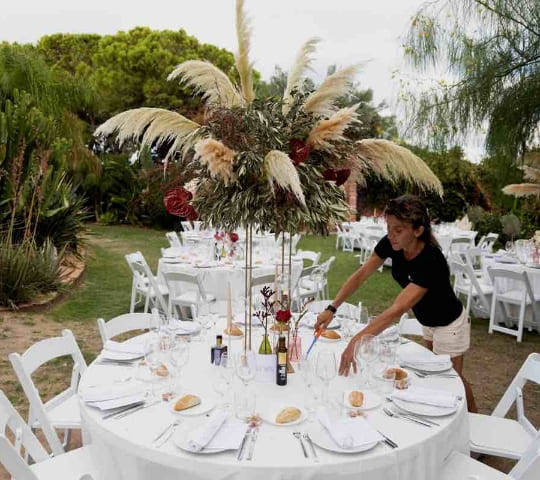
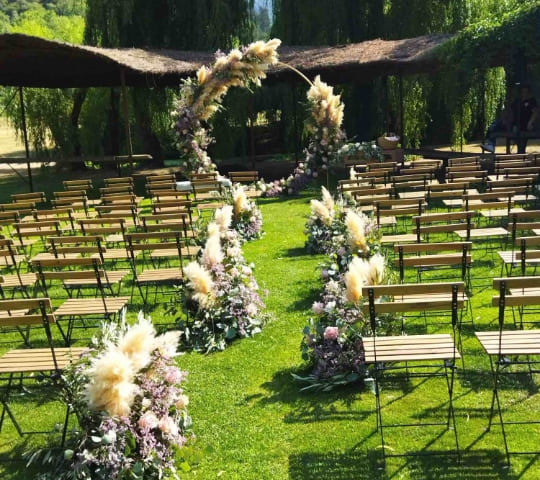
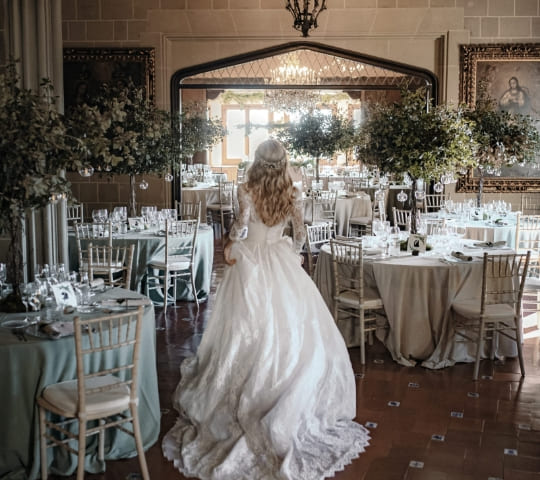
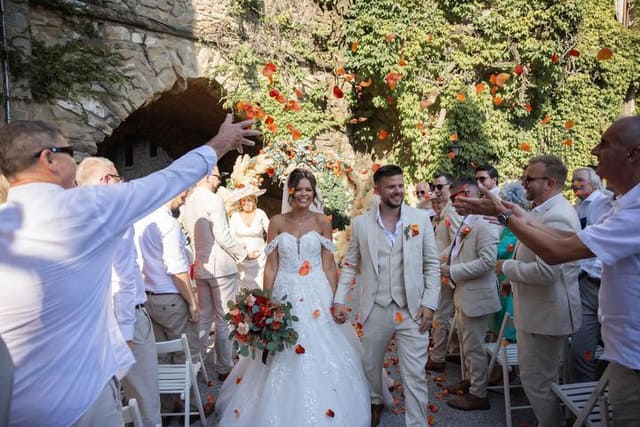
Trained at the Escola d’Art Floral de Catalunya, with more than ten years spent designing flowers for weddings across Barcelona and its province, I approach a wedding as one floral scheme rather than a list of separate arrangements. The ceremony, the tables and the flowers the bride carries share a palette, a set of varieties and a single idea, because I design and install all of it myself.
That also means you deal with me directly at every stage, from the first conversation about your venue to the morning of the wedding, when I arrive to set everything up.
Floral decoration for weddings in Barcelona
Floral decoration covers much more than the pieces people picture first. It starts at the entrance your guests walk through and finishes at the last table of the dinner, and it works best when every part of it speaks the same language. A wedding where the ceremony flowers and the reception flowers look like they came from two different suppliers is a wedding that never quite settles, however beautiful each piece is on its own.
So before I design anything, I want to see the venue and understand the day: the light at the hour you marry, the colour of the stone or the walls, how guests move from one space to the next. The flowers then follow that, rather than being placed on top of it.
Ceremony flowers: arches, aisles and altars
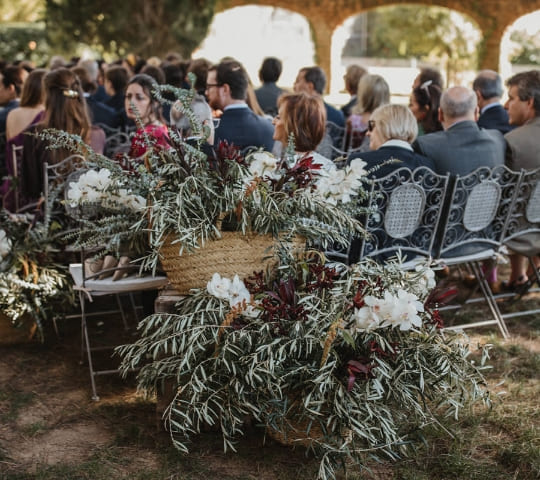
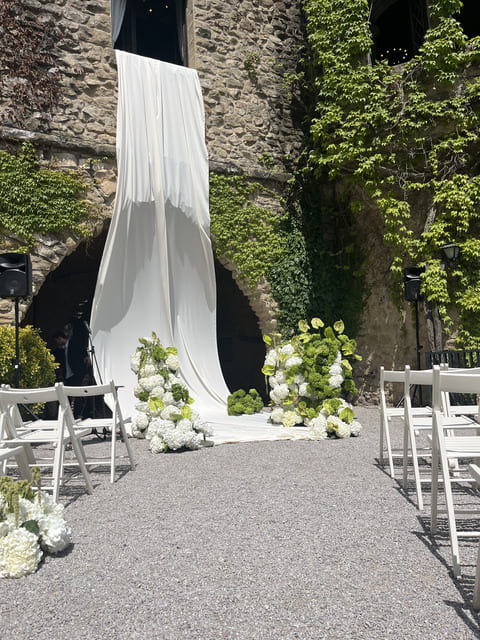
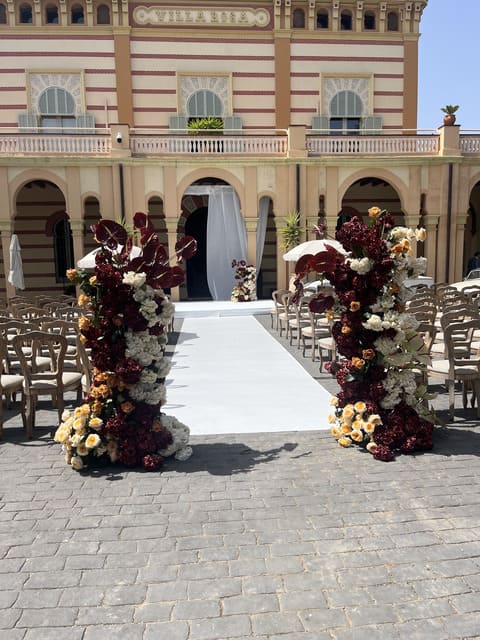
The ceremony is where flowers do the most visible work, because it is the one moment when everybody is looking in the same direction. Scale matters more than quantity here: a piece that looks generous indoors can disappear entirely against an open sky, and one that works in photographs from the front can look thin from the side.
For outdoor ceremonies I build with movement and asymmetry, using varying heights so the arrangement reads as something that grew there rather than something that was delivered. I also design for the conditions — wind, afternoon heat and long ceremonies are real constraints in this part of the coast, and they decide which varieties can be used and how they are conditioned beforehand.
For ceremonies held in a church or an indoor space, the architecture usually gives me the structure, and the work becomes about restraint: fewer, larger gestures that hold their own against the room.
Flowers for the reception and the tables
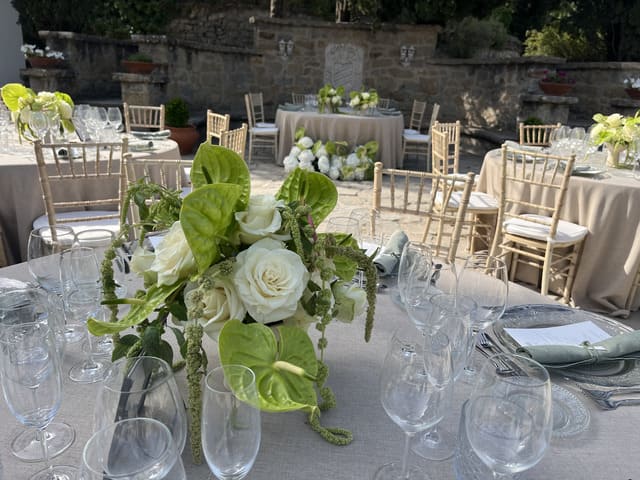
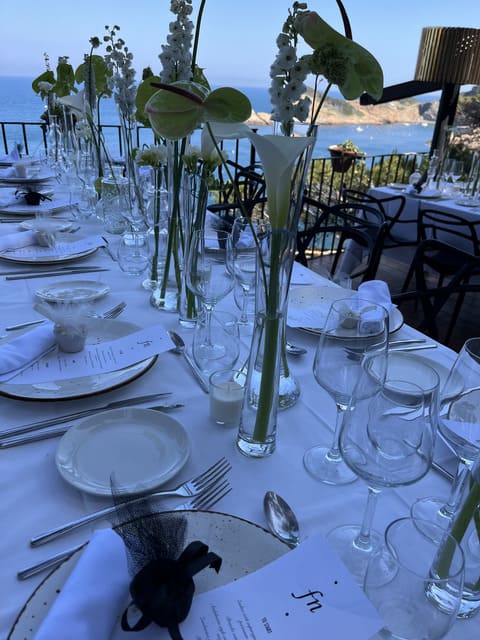
At the reception the flowers stop being a focal point and start being an atmosphere. Table arrangements need to sit either below or well above eye level, so nobody spends dinner talking around a bouquet. Beyond the tables there is the aperitif area, the entrance, the seating plan and the spaces guests pass through without noticing
I usually repeat two or three varieties from the ceremony across the reception, which is what gives the day its continuity. Where it makes sense, I also move the larger ceremony pieces to the dinner space during the aperitif, so that work you have paid for is seen twice rather than once.
Seasonal flowers in Catalunya and your colour palette
I buy according to what the season is actually giving, not from a fixed list drawn up months in advance. Flowers grown for the moment they are used are stronger, they open properly, and they hold up through a long celebration.
Spring gives peonies and ranunculus, and their density suits softer, more romantic palettes. Late summer and autumn bring dahlias, with deeper and warmer tones. Roses are dependable most of the year and are the reason so many schemes are built around them. Hydrangeas are beautiful and difficult in real heat, so I use them where the setting allows it. Running through all of it is the greenery of this region which is what makes an arrangement look as though it belongs in Catalunya rather than anywhere else. If you are still deciding, it helps to understand how each variety behaves once it is cut.
Colour usually follows from two things: the season and the venue. A palette that sings against warm stone at six in the evening can look washed out in a white, modern space at midday, and part of my job is to notice that before we commit to it.
Planning your wedding flowers from abroad
A good share of the weddings I work on are planned from another country, and the distance changes the process rather than the result. I visit the venue myself and, when you cannot be there, I take you round it on a video call so you see the spaces, the light and the proportions with your own eyes instead of through a photograph.
From there the conversation happens remotely: images, palettes and honest opinions about what will and will not hold up on the day. You are not required to be in Barcelona for any part of the design, and on the morning of the wedding I deliver and install everything on site.
Why work with a wedding florist and floral designer
Most couples end up hiring the organisation and the flowers from two separate suppliers, and then spend months acting as the link between them. I work as a wedding planner and florist at the same time, so the floral design is not a service bolted on at the end.
In practice that means fewer conversations for you and better coherence for the wedding. The bridal bouquet, the buttonholes, the ceremony and the tables are all decided in one place, by one person, at the same time.
Frequently asked questions
Frequently asked questionsThe ones in season at the time you marry, because they last longer and cost less for the same effect. In practice that means peonies and ranunculus in spring, dahlias towards autumn, and roses and local Mediterranean greenery almost all year round.
I am based in Vilassar de Mar and work across the whole province of Barcelona — the city, the Maresme, the Vallès and Sitges among them. Flowers are prepared in my studio and installed on site on the day.
Three to four months is comfortable, once the venue and the general style of the day are settled. The final varieties are confirmed much closer to the date, when I know what will actually be available that week.